About the Author

Pen vs Sword is an independent magazine publishing long-form cultural criticism, art history and political analysis. We write about artists, movements, thinkers and ideas - from Peter Kennard to Hurufiyya, from the Suffragette movement to the French Revolution. Free to read, independently published.




A guide to how power changes
Every right that exists was once demanded. The right to vote, to organise, to speak freely, to be free from arbitrary imprisonment, none of these came as gifts from those who held power. They were extracted, argued for, marched for, struck for, bled for. The history of activism is the history of ordinary people insisting that the world could be arranged differently and, often enough, making it so.
This is not a comfortable history. It is full of people who were ridiculed, imprisoned, tortured and killed for positions that history has since vindicated. It is a history of failure as much as success, of partial victories and devastating setbacks. But it is also, unmistakably, the history of progress itself and of every social advance that distinguishes the present from the past.
Understanding the history of activism is not merely an academic exercise. It is a guide to how power changes and what it takes to change it. Whether you are reading this in the middle of your own campaign, trying to understand a movement in the news, or simply attempting to make sense of why the world is the way it is, this history belongs to you.
For more on the power of protest and resistance, explore the connected articles across Pen vs Sword from individual activists to the movements that shaped history.
For more writing on Resistance & Solidarity in art, culture and political struggle, read related articles across Pen vs Sword
“The voice of the people, once raised in unity, cannot be silenced.”
Maximilien Robespierre
All of our content is free to access. An independent magazine nonetheless requires investment, so if you take value from this article or any others, please consider sharing, subscribing to our mailing list or donating if you can. Your support is always gratefully received and will never be forgotten. To buy us a metaphorical coffee or two, please click this link.
Table of Contents
From Page to Object
This article inspired something physical. View in the Propaganda Department.
Vive La Résistance Print | Revolution Print | Rose Diagrams T-shirt | Peter Kennard Collection
What is activism and why does it matter?
Activism is the deliberate effort to bring about political, social, economic or environmental change. It can take countless forms, from a petition signed at a kitchen table to a march of ten thousand people, from a hunger strike conducted in a prison cell to a legal challenge in the highest court in the land. What all of these have in common is intention: the decision, made by individuals or groups, that the current state of affairs is unacceptable and that something must be done.
The word itself is relatively recent, but the practice is ancient. Wherever one group of people has held power over another whether through violence, law, tradition or economic coercion, others have found ways to resist, challenge and refuse. Protest is as old as hierarchy. What changes across history is not the fundamental impulse but the tactics available, the legal context in which they are pursued, and the particular forms of injustice that demand a response.
Studying the history of activism matters for several reasons. First, because it corrects a persistent distortion in how history is usually taught: the illusion that change is produced by great individuals or inevitable forces rather than by organised collective action. Second, because it provides a practical inheritance with a record of what has worked and what has failed, under what conditions and at what cost. And third, because it is simply one of the most extraordinary stories there is: the story of people, often without resources or institutional support, deciding that the world could be different, and making it so.
The study of protest history also requires resisting a very common temptation: the temptation to make the past seem inevitable. Looking back, we know that the suffragettes won, that apartheid fell, that the labour movement forced through the eight-hour working day. It is easy to imagine that these outcomes were always coming. But to those who lived them, nothing was inevitable. They were acting against a world that had every reason to continue exactly as it was.

Early protests and revolts – from bread riots to slave rebellions
The history of activism does not begin in the nineteenth century or the age of print. It begins wherever there were people, which is to say, it begins at the beginning. Slave revolts in ancient Rome, peasant rebellions in medieval Europe, food riots in early modern cities: these were not simply outbursts of violence or desperation. They were, in their different ways, political acts, they were refusals to accept a distribution of power and resources that those at the bottom had not chosen and did not consent to.
Among the most extraordinary of early modern protests was the Women’s March on Versailles of October 1789. On the morning of 5 October, a group of women gathered in the markets of Paris, driven by hunger and fury over rising bread prices. What began as a local grievance grew, within hours, into a march of thousands heading for Versailles – armed with kitchen knives and pikes – demanding that King Louis XVI return to Paris, where the people could watch him. By the following morning, they had succeeded. The royal family was escorted back to the capital. It was one of the most decisive acts of popular power in the history of the French Revolution, and it was led by ordinary working women.
You can read the full story of this remarkable moment in our detailed article on the Women’s March on Versailles, which remains one of the most powerful examples of what collective action, led by those with the most to lose can achieve.
What the Women’s March demonstrated, with devastating clarity, is that power is never simply held. It is performed, maintained and contested – and those who contest it, with sufficient numbers and sufficient determination, can win. This insight runs through every movement in this guide.
“You cannot buy the revolution. You cannot make the revolution. You can only be the revolution.”
Ursula K. Le Guin
The suffragette movement – women fighting for the vote
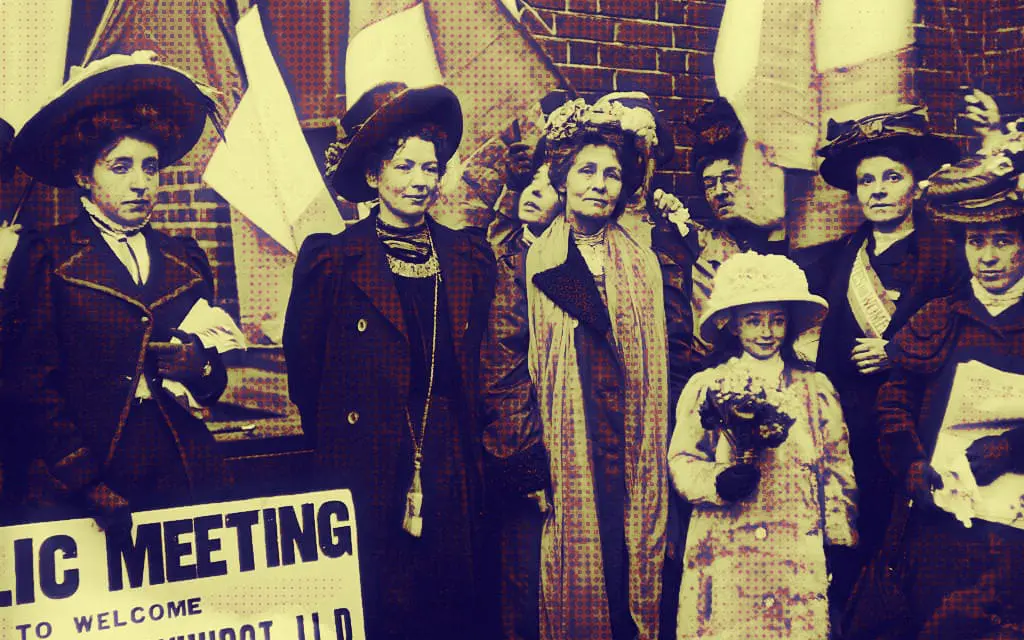
The campaign for women’s suffrage – the right to vote – lasted, in Britain, from the 1860s to 1928. It involved decades of lobbying, marching, petitioning and, ultimately, direct action: window-smashing, arson, hunger strikes and forced feeding in prison. It was not a single movement but a coalition of movements, disagreeing constantly about tactics and targets, united only by the conviction that women’s exclusion from political life was indefensible.
The story of the Pankhurst sisters – Emmeline, Christabel and Sylvia – is one of the movement’s great dramas. Emmeline founded the Women’s Social and Political Union (WSPU) and championed increasingly militant tactics. Christabel supported her mother’s escalating strategy. Sylvia, working in the East End of London, refused: she believed that working-class women’s liberation had to be part of any genuine suffrage movement, not an afterthought. The three sisters’ divergence is a microcosm of a tension that runs through activist history, between those who want to move fast and those who want to move together. Explore the full story of the suffragette movement and the women who built it.
“In a time of universal deceit, telling the truth is a revolutionary act.”
George Orwell
The Matchgirls’ Strike of 1888 belongs to the same era and the same struggle. When young women at the Bryant & May match factory in east London walked out over toxic working conditions and poverty wages, they were not just demanding better treatment. They were insisting, in one of the most precarious positions imaginable, that their lives and their health were worth protecting — that the labour of women, like the labour of men, had rights attached to it.
The Matchgirls’ Strike of 1888 is one of the founding moments of the modern British trade union movement. Its lessons, that workers without power can still organise, that solidarity across divisions of gender and class is possible remain as relevant as ever.
Labour activism and the fight for workers’ rights
The industrial revolution created wealth on an unprecedented scale and distributed almost none of it to those who produced it. Working conditions in the factories, mills and mines of nineteenth-century Britain were lethal. Children worked in coal mines. Women worked fourteen-hour days. Men died in machine accidents and lung disease at rates that would provoke outcry today. The labour movement grew from the simple, radical insight that those who do the work should have a say in how it is done and how its rewards are distributed.
From the Chartists of the 1830s and 1840s to the trade union federations of the early twentieth century, to the general strikes that forced through minimum wage legislation and the welfare state, the labour movement is the longest-running and most practically consequential activist tradition in modern history. It is also the tradition most likely to be underestimated, partly because its victories are now so embedded in everyday life that they have ceased to look like victories at all.

The eight-hour working day, the weekend, the minimum wage, paid holidays, sick pay, health and safety legislation: none of these were gifts. Every one of them was won by organised workers who struck, picketed, negotiated and, sometimes, died for them. Understanding this history is not nostalgia. It is the precondition for understanding why the same fights are recurring today, in different forms, across the gig economy, the logistics sector and the warehouses of the digital age.
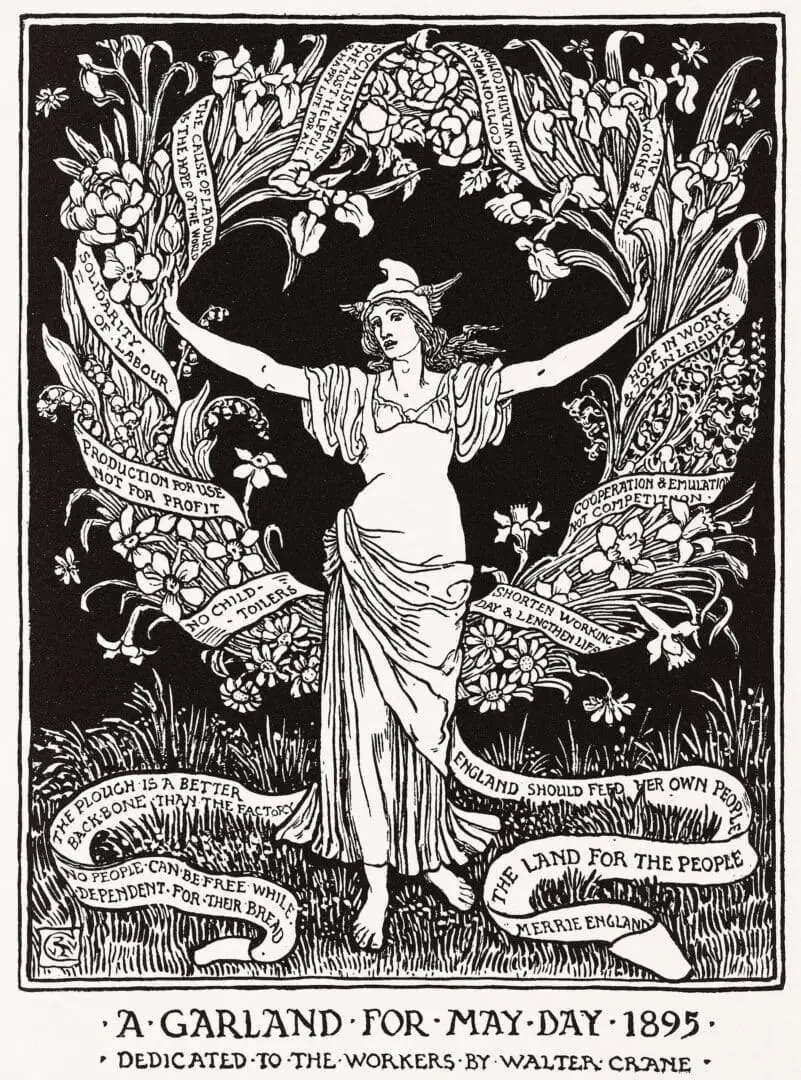
The tradition of political art that supported the labour movement has its own history, and it begins much earlier than most people realise. Walter Crane’s A Garland for May Day, produced in 1895 for the socialist newspaper The Clarion, is one of the most beautiful examples of art in the service of political solidarity and a work that understood, long before the term “activist art” existed, that beauty and struggle are not opposites.
Read our full article on A Garland for May Day and how the Arts and Crafts movement aligned itself with socialist politics in late Victorian Britain.
“If you are neutral in situations of injustice, you have chosen the side of the oppressor.”
Desmond Tutu
Civil rights movements – race, equality and resistance
The civil rights movements of the twentieth century represent some of the most sustained, sophisticated and historically consequential protest campaigns ever mounted. From the Montgomery Bus Boycott of 1955–56 to the marches on Washington and Selma, from the Freedom Rides to the sit-ins at Greensboro lunch counters, the American civil rights movement waged a disciplined, strategic campaign of non-violent direct action against a system of racial terror and legal subjugation that had persisted for centuries.
Angela Davis, who grew up in the segregated Birmingham of the 1940s, a city so violently racist it was known as “Bombingham”, represents one strand of the movement’s evolution: from non-violence toward a more confrontational assertion of Black power, Black self-determination, and the systemic analysis of racism’s relationship with capitalism. Her case, placed on the FBI’s Most Wanted list, imprisoned, acquitted became in the early 1970s a global symbol of resistance. Davis understood, and continued to argue for decades afterward, that genuine liberation required not just legal reform but the dismantling of the prison-industrial complex itself.
Che Guevara traced a very different path through the same historical moment. Where the American civil rights movement pursued change through legal and political channels even as its more radical wings challenged those channels, Guevara argued for armed revolution as the only adequate response to colonial exploitation and imperial violence. His execution in Bolivia in 1967 made him a martyr for the global left, and his image (Korda’s photograph, reproduced billions of times) became perhaps the most recognisable face of twentieth-century radicalism. The debate between his approach and the non-violent tradition continues to shape activist politics today.
In the Soviet bloc, resistance took different forms. Alexei Navalny‘s anti-corruption campaigns, his survival of a poisoning attempt, and his death in an Arctic prison in 2024 place him in a tradition of dissidence that stretches from the Soviet era to the present: the tradition of those who confront authoritarian power from within, at extraordinary personal cost, and refuse to leave.
The Rosenstrasse Protest of 1943 in which non-Jewish German women stood in the street for a week until the Gestapo released their Jewish husbands, is one of the most remarkable instances of successful resistance under the most extreme conditions imaginable. Read the full story in our article on the Rosenstrasse Protest.
The peace activism of Concepcion Picciotto, who maintained a continuous vigil outside the White House for over thirty years demanding nuclear disarmament, belongs to the same tradition of sustained, non-violent refusal by making visible, through sheer physical presence and moral commitment, what power would prefer to keep invisible.
Explore the complete tradition of resistance and solidarity this pillar maps
“The most disrespected person in America is the Black woman. The most unprotected person in America is the Black woman.”
Malcolm X
LGBTQ+ activism from Stonewall to today
In 1967, consensual homosexual acts between adult men were partially decriminalised in England and Wales. This was not a gift from the powerful. It was the result of decades of organising, lobbying, and simply surviving in a society that treated gay men as criminals and gay women as invisible. Two years later, in New York, the Stonewall Inn was raided by police. The patrons, many of them transgender women of colour, many of them homeless, all of them with nothing left to lose fought back. The riots that followed became the founding moment of the modern LGBTQ+ rights movement.
Marsha P. Johnson, a transgender woman of colour who was present at Stonewall and spent the decades that followed doing direct support work for the most vulnerable people in New York’s streets, exemplifies a tradition of activism that combined visibility, solidarity and a refusal to make oneself respectable for the comfort of the mainstream.
Peter Tatchell, who has attempted citizen’s arrests of Robert Mugabe and tried to disrupt the Archbishop of Canterbury’s Easter sermon, occupies the same tradition in British public life: the understanding that change does not happen by waiting politely to be included, but by making the status quo impossible to maintain. For over five decades Tatchell has combined media-savvy direct action with careful legal and political strategy – a combination that has made him one of the most effective, and most controversial, activists in British history.
The gains of the LGBTQ+ movement, decriminalisation, civil partnerships, equal marriage, the gradual dismantling of the legal structures of persecution are real and hard-won. So are the losses, the backlash, and the new forms of hostility that have emerged in the early twenty-first century. Read our full article on the history of LGBTQ+ rights for the complete timeline from criminalisation to pride.
The campaigns of Darcus Howe, a broadcaster, journalist, activist, and one of the most important voices in British Black public life, traced a parallel arc through the same decades, confronting institutional racism with a combination of fury, intelligence and what can only be described as refusal: the refusal to be defined by what Britain said he was.
“I am not a violent man. But I am also not a passive one.”
Nelson Mandela
Climate activism – the new generation of protest
The twenty-first century has produced a new generation of protest confronted with a crisis that previous generations did not face: the prospect that the planet’s systems, taken together, cannot sustain the way of life that industrial capitalism has made possible. The climate movement is the largest social movement in human history by some measures, drawing millions onto the streets in coordinated global actions.
Greta Thunberg began striking outside the Swedish parliament in August 2018, alone, with a handmade sign. Within months, her Fridays for Future movement had spread to 180 countries. Her achievement was not, as is sometimes suggested, merely symbolic. By making the climate crisis a question of moral responsibility by asking, with devastating directness, why adults were failing to act on what scientists had been saying for decades, she shifted the terms of the public debate in ways that official channels had failed to do.
Roger Hallam, who co-founded Extinction Rebellion, argues that only sustained mass civil disobedience, by accepting arrest in large numbers until governments are forced to respond, can produce the systemic changes that incremental politics has failed to deliver. His position is contested, inside and outside the climate movement, but it draws on a serious analysis of why previous campaigns have succeeded or failed: the evidence that large-scale disruptive protest, combined with clear demands and a willingness to absorb state repression, has historically forced governments to negotiate.
The Stop the War Coalition, organised the largest protest in British history, the march of 15 February 2003, when between one and two million people took to the streets of London to oppose the invasion of Iraq. The invasion happened anyway. What Stop the War‘s partial failure illustrates is one of activism’s most difficult truths: that even the most successful protests do not always produce the outcomes they demand. But they change what is politically possible; they shift the terrain on which future battles are fought; and they create the communities of resistance that will be needed for the struggles ahead.
Find out more about what activists have always been fighting for – a different future
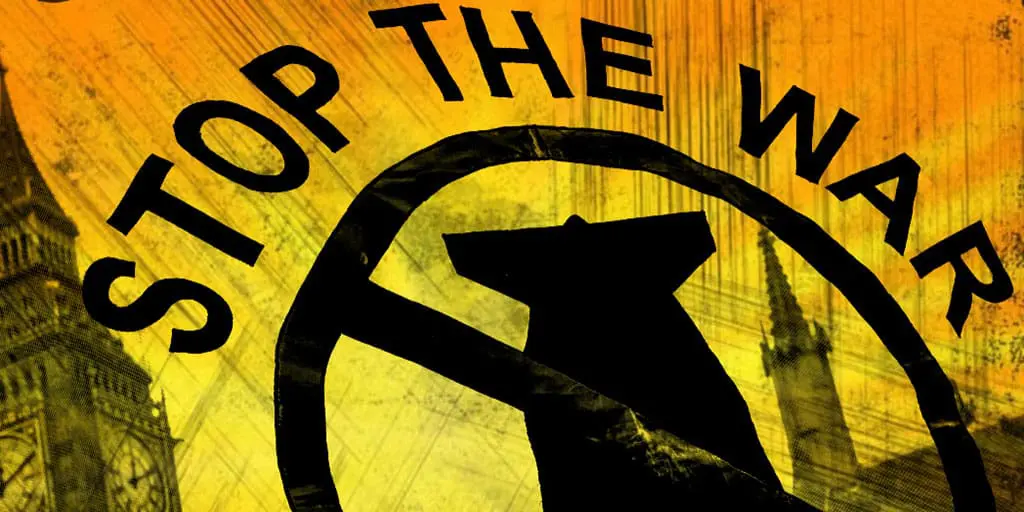
“Protest beyond the law is not a departure from democracy; it is absolutely essential to it.”
Howard Zinn
How protest tactics have evolved through history
The history of activism is also the history of a running debate about tactics. Every movement has had to decide: petition or march? Lobby or strike? Civil disobedience or electoral politics? Non-violence or, in the most extreme cases, armed resistance? These are not merely strategic questions. They are moral ones, and the answers have changed across contexts and generations.
Non-violent direct action, as theorised and practised by Gandhi, Martin Luther King Jr and many others, rests on a specific claim: that moral witness has political force, that suffering borne openly and publicly can change the minds of opponents and onlookers, and that violence, even in response to violence, corrupts the movement that uses it. This tradition has produced some of activism’s greatest victories. It has also produced, at different times and in different contexts, its greatest failures by leaving practitioners exposed to violence that non-violence alone could not stop.
Anarchism, which has its roots in the work of Proudhon, Kropotkin and Emma Goldman, offers a systematic argument that the state itself is a form of domination and that hierarchy is not natural but constructed, and that genuine human freedom requires not the reform of power but its abolition. This tradition has produced a distinctive set of tactics: mutual aid, affinity groups, consensus decision-making, and a deep suspicion of movements that replicate hierarchical structures in the act of opposing them.
What can we learn from the history of protest?
What the history of activism shows, across all these differences, is that no single tactic works in all contexts, and that the movements most likely to succeed are those with the flexibility to use different approaches at different stages, and the strategic intelligence to know which moment calls for which approach. This is the inheritance that the history of protest leaves to those who engage with it seriously: not a formula, but a set of hard-won lessons about what works, what fails, and why.
The story of activism is not finished. It is, in all likelihood, entering one of its most consequential chapters as climate breakdown, inequality, and the erosion of democratic norms create conditions in which the question of what ordinary people can do against extraordinary power is not academic but urgent. The answer this history gives is not a comfortable one. But it is, on the evidence, a hopeful one: it has been done before, against odds that seemed equally impossible, by people who had no more power than we have now.
Read even more of our full articles on the complete tradition of resistance and solidarity this pillar maps, Howard Zinn – A People’s History and radical truth-telling, Desmond Tutu – archbishop, activist and moral compass and Revolution and civil war – how upheaval reshapes history
For more on the tradition of resistance and collective action, explore our Resistance and Solidarity hub, our account of the French Revolution and the modern tradition of popular protest, and the story of the Women’s March on Versailles – the founding moment of collective political action.
Pen vs Sword Books – Book Recommendations
*All Book Links Open a New tab to our Pen vs Sword Books Bookshop
**If you buy books linked to our site, we get 10% commission from Bookshop.org, whose fees support independent bookshops.
1. A People’s History of the United States by Howard Zinn
The essential counter-narrative to official history – told from the perspective of those who protested, organised and resisted from the very beginning. PVS essential reading.
2. Women, Race and Class by Angela Davis
Davis’s foundational text on the interconnections between gender, race and class – essential reading for understanding modern protest movements.
3. This Is Not a Drill: An Extinction Rebellion Handbook by Extinction Rebellion
The contemporary playbook for non-violent direct action – both a manifesto and a practical guide to the new wave of climate activism.
4. My Life So Far by Jane Fonda
Fonda’s memoir traces her evolution from actress to Vietnam War protester to climate activist – a vivid portrait of a life shaped by activism.
5. How to Lose a Country by Ece Temelkuran
The most urgent guide to democratic backsliding in print – written from direct experience of what happens when activism fails to hold the line.
6. The Fire Next Time by James Baldwin
Baldwin’s masterwork on American race – the most honest and devastating examination of why protest is not optional but necessary.
7. Long Walk to Freedom by Nelson Mandela
Mandela’s autobiography traces one of the great protest-to-power stories of the twentieth century – essential and deeply human reading.
“Until the great mass of the people shall be filled with the sense of responsibility for each other’s welfare, social justice can never be attained.”
Helen Keller
JOIN THE PVS READERSHIP
Browse 1000’s more Books in Our Pen vs Sword Books Bookshop
About the Author
Pen vs Sword is an independent magazine publishing long-form cultural criticism, art history and political analysis. We write about artists, movements, thinkers and ideas - from Peter Kennard to Hurufiyya, from the Suffragette movement to the French Revolution. Free to read, independently published.












Post Comment