From propaganda to protest art, from state-sanctioned murals to anonymous wheat-paste – how art and power have always been inseparable
ART IS NEVER NEUTRAL
Art and Power often lock horns. Every image is an argument. Every aesthetic choice reflects a set of values. The decision about what to depict, how to depict it, who commissions it, who hangs it, who destroys it — all of these are political decisions, whether or not they present themselves as such. The history of art is, in large part, the history of that argument: between those who use visual culture to naturalise and celebrate existing power, and those who use it to question, challenge, subvert or refuse it.
Art and Power is Pen vs Sword’s lens for examining that argument. It is concerned with the full range of visual culture, be it painting, sculpture, photography, graphic design, street art, film, digital image-making – as a site where power becomes visible, where ideology is inscribed in form, where resistance finds its most durable expression. The articles collected here do not separate aesthetics from politics. They insist that the two have never been separate.
This is not a neutral subject. The question of how art and power relate is itself a contested one, with different traditions offering radically different answers. Formalist art criticism insists on the autonomy of the aesthetic object, independent of its social function. Marxist and feminist art history insists that such autonomy is itself ideological, that it conceals the conditions under which art is made, distributed and valued. Post-colonial criticism adds a further dimension: that the Western canon’s claim to universal aesthetic standards is a form of cultural imperialism that has systematically excluded and devalued non-Western visual traditions.
The articles on this page take the contested, political nature of visual culture as their starting point. They are interested in who makes art, who pays for it, who controls where it is seen and who sees it, and what work it does in the world.
ART & POWER
VISUAL CULTURE, RESISTANCE, MEANING
Art cannot be disentangled from power whether it is weaponised by institutions or used to resist them. Visual culture conditions how we perceive justice, history, freedom, and even our own bodies. The articles here help us see that the politics of imagery is not just about meaning, but about who controls meaning. If language can shape reality, art stakes a claim on how we experience it.
Table of Contents
What is art as a form of power?
Art has served power since the first pharaoh commissioned a monument. The pyramids, the Parthenon, the Palace of Versailles, the Socialist Realist murals of the Soviet Union, the brand identities of global corporations: all of these are exercises in using visual culture to project authority, naturalise hierarchy, and make the existing order of things seem inevitable, permanent and beautiful. Understanding this tradition is the precondition for understanding its opposite.
The relationship between art and power is not simply one of domination and resistance. It is more complicated, more interesting, and more uncomfortable than that. Artists who work within state institutions, the court painters, official war artists, commissioned muralists who are not simply propagandists, even when their work serves propaganda functions. They bring their own aesthetic priorities, their own subversions, their own negotiations with the authority that pays them.
This section brings together writing on art movements, individual artists, visual cultures and historical moments where aesthetics and authority collide. Rather than treating art as isolated or decorative, Pen vs Sword approaches it as a social force: embedded in ideology, shaped by material conditions, and capable of both complicity and critique.
And artists who work in opposition to power are not simply free. They are shaped by what they are opposing, constrained by the materials and platforms available to them, dependent on the very cultural institutions they seek to challenge. To understand the full arc of this tradition, explore our complete guide to art movements from 1850 to now.
FEATURED ARTICLE: THE GUERRILLA GIRLS
Feminist art activism and the politics of representation
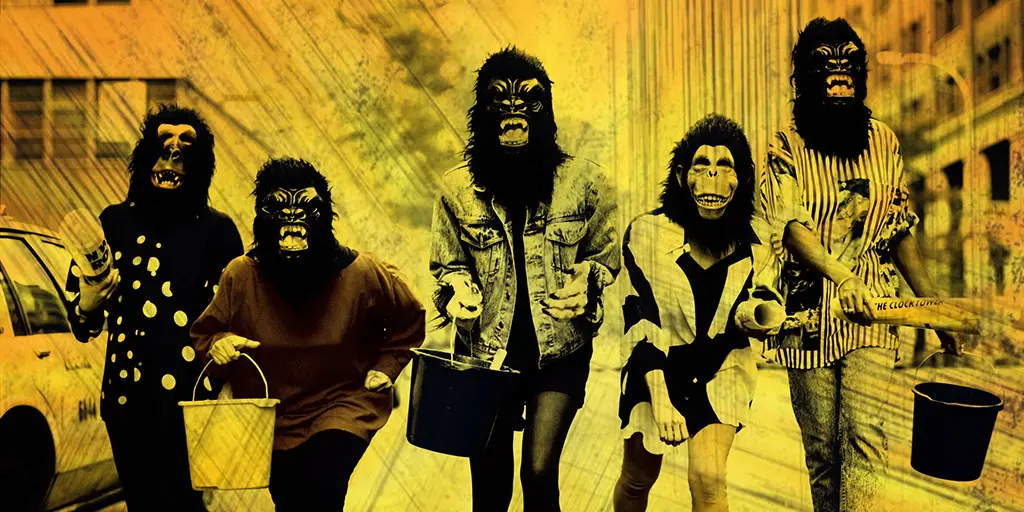
The Guerrilla Girls use humour, anonymity and provocation to expose sexism and racism at the core of the art world — from MoMA exhibitions to global culture industries. Their work reveals how visual language can be wielded as both critique and spectacle.
PETER KENNARD – THE CANVAS OF CONSCIENCE
Political photomontage as resistance
Peter Kennard’s art wrestles with war, capitalism and social injustice, using photomontage to expose power structures that are often invisible in daily life. His work isn’t comfortable to look at — it demands reflection.
Propaganda, patronage and the uses of state art
The history of state patronage is a history of art pressed into the service of legitimation. Medieval cathedrals were built to make the power of the Church visible and overwhelming. Renaissance princes commissioned paintings that placed them in classical and biblical narratives of authority. The Baroque style was developed in direct response to the Counter-Reformation’s need for an art that was emotionally overwhelming, sensually rich, and designed to draw the viewer into identification with the Church’s worldview.
In the twentieth century, state patronage reached its most systematic and most brutal form in the totalitarian regimes of Europe. Nazi art celebrated racial ideology through an academic realism that the avant-garde had supposedly transcended. Soviet Socialist Realism depicted the heroic worker and the benevolent state in terms that functioned as direct visual propaganda, with artists who departed from the approved style facing censorship, imprisonment, or death.
But state patronage has never been the monopoly of authoritarian regimes. The tradition of political art that grew alongside the labour movement has its own history. A Garland for May Day — Walter Crane’s 1895 image for the socialist newspaper The Clarion is one of the most beautiful examples of art in service of political solidarity: a work that understood, long before the term “activist art” existed, that beauty and struggle are not opposites.
DADA AND THE INVENTION OF THE AVANT-GARDE
When art rebelled against rationalism and power
Born in the shockwaves of World War I, Dada rejected conventional aesthetics and proposed art as tactic — a means of cultural sabotage. From sound poems in Zurich to anti-art photomontage in Berlin, Dada’s legacy still shapes critical visual practice.
THE BLACK ARTS MOVEMENT – CULTURE AS RESISTANCE
Art, politics and Black liberation
The Black Arts Movement turned culture into a battleground, using poetry, visual art and performance as tools of political struggle. This piece examines how aesthetics became inseparable from activism, and how art was mobilised as a direct challenge to racial power structures in America.
Political art and protest – when images become weapons
The tradition of protest art is as old as the tradition of state art, and the two have always defined themselves against each other. Daumier’s caricatures of the French ruling class in the 1830s were political cartoons in the most literal sense: they got him imprisoned. Goya’s Disasters of War series documented the atrocities of the Napoleonic occupation of Spain with a documentary frankness that official art was constitutionally incapable of.
Peter Kennard, whose photomontages have been one of the most sustained and powerful examples of British political art for the past five decades, works in a tradition that understands the image as a direct political instrument. His work on nuclear weapons, on the Iraq War, on Palestine, combines found photographs into compositions of devastating clarity, making visible the connections that official imagery is designed to conceal. His images have appeared on placards, in newspapers, on gallery walls, and on the streets: each context changing the work’s meaning and reach.
The Guerrilla Girls, who have been wheat-pasting provocative posters around New York in gorilla masks since 1985, turned the weapons of advertising, the billboard, the poster, the shocking statistic against the art world itself. Their work exposed, with devastating precision, the systematic exclusion of women and artists of colour from museum collections and gallery shows. It was a form of political art that required no gallery to function, and was more powerful for it.
The story of how political art operates in the contemporary digital landscape and how platforms censor it is traced in our article on Pixels of Protest, threads of resistance, which documents Meta’s suppression of a Palestine solidarity artwork and what it reveals about the new gatekeepers of visual culture.
LOWKEY: MUSIC, MEMORY & POLITICAL VOICE
Hip-hop, dissent and contemporary power
Lowkey’s work shows how music can function as both cultural memory and political intervention. This article explores how lyricism, identity and geopolitics intersect, and how art continues to operate as a vehicle for critique, solidarity and resistance.
THEO JANSEN: ENGINEERING LIFE IN MOTION
Kinetic sculpture, imagination and artificial nature
Theo Jansen’s Strandbeests blur the line between art, engineering and biology. This piece explores how his moving sculptures challenge ideas of authorship, control and creation, revealing how artistic experimentation reshapes our understanding of life, technology and power.
Art movements as political acts – AFRICOBRA, Hurufiyya and global visual resistance
The most radical interventions in the relationship between art and power have often come from collective movements that challenged the fundamental terms on which visual culture was organised. AFRICOBRA the African Commune of Bad Relevant Artists, founded in Chicago in 1968, declared that Black art should be made by and for Black communities, answering to Black criteria of value rather than those of the white art world. Its visual language of vibrant colour, energetic line and explicit political content was not simply political in subject matter. It was political in its fundamental assertion of the right to self-definition.
The Black Arts Movement provided the cultural framework within which AFRICOBRA operated and was a declaration that Black cultural production had its own criteria, not derived from the white art world’s standards. Together, they represent the most comprehensive challenge to the racial politics of Western visual culture mounted in the twentieth century.
The Hurufiyya movement in the Arab world emerged across Iraq, Tunisia, Morocco and the Gulf from the 1940s onwards and reclaimed Arabic calligraphy as a vehicle for modernist visual expression. The assertion of Arabic script as a legitimate foundation for contemporary art was, in this context, a political act: a refusal of the equation between modernity and Western aesthetic standards that underpinned much of the international art world’s self-understanding.
The feminist art movement – from Judy Chicago’s The Dinner Party to Barbara Kruger’s text-image combinations, from Cindy Sherman’s self-portraits to the Guerrilla Girls’ institutional critique, constituted perhaps the most fundamental challenge to the power relations embedded in Western visual culture. It did not simply add women’s perspectives to an existing conversation. It challenged the entire framework within which that conversation had been conducted.
The Gutai group in Japan were producing performance art and installation work before those terms existed in the West, posed their own challenge to what art was allowed to be, insisting on the body, the material and the irreducibly physical in a context that the Western avant-garde had barely begun to consider. Their story raises the questions about who gets to be part of art history that remain unanswered today.
VISUAL DEEP DIVE THE GUTAI MOVEMENT
Art born from rupture and reinvention
Emerging in post-war Japan, the Gutai collective reimagined art as action — playful, experimental, material-driven and deeply political. By breaking conventions, Gutai artists pushed art into new domains of meaning and collective experience.
Visual culture in the digital age – memes, algorithms and the new image wars
The relationship between art and power has been transformed by the digital revolution, in ways that are still being worked out. The democratisation of image-making and image-distribution, the smartphone, social media, the meme, has given new tools to both power and its challengers. Authoritarian governments use social media to spread disinformation and suppress dissent. Protest movements use the same platforms to coordinate, document and amplify.
The algorithm has become a new form of cultural gatekeeping and they are invisible, opaque and extraordinarily powerful. What images circulate, which artists are seen, what visual culture reaches which audiences: all of this is now shaped by systems whose criteria are commercial rather than aesthetic or political. Ecological art is arguably one of the most politically urgent contemporary practices and is particularly vulnerable to this kind of marginalisation, as its subjects are precisely those that the platforms of commercial culture have the least interest in amplifying.
The articles gathered on this page, from our accounts of propaganda and state art to our profiles of Peter Kennard’s art of protest to our analysis of contemporary visual culture are exercises in looking harder: not just at what is in the image, but what it is doing, who made it, who is showing it, and who it is for. The evolution of this conversation is traced across five decades in our article on the evolution of art and design since 1960.
BRUTALISM – CONCRETE, IDEOLOGY & POWER
Architecture, authority and the politics of form
Brutalism is more than an architectural style – it is a statement about power, authority, and the social ambitions of the modern state. This article explores how concrete megastructures became symbols of both utopian idealism and institutional control, revealing how visual form, ideology, and politics collide in the built environment.
THE BIGGER PICTURE
Art does not end at the edge of the canvas. It spills into every other question this magazine asks: who resists, who tells the truth, who imagines a different future, who controls the means of cultural production. The image and the argument are not separate things, they have always been different forms of the same refusal. To read the articles in this section alongside those in Resistance and Solidarity is to understand that protest has always needed a visual language, and that visual language has always carried a politics.
To read them alongside Language, Media and Truth is to understand that the battle over images and the battle over narratives are the same battle, fought on different terrain. And to read them alongside Culture and Capital is to understand who owns the terrain itself – who funds the galleries, who controls the platforms, who decides what counts as art and what counts as noise. Art and power are inseparable. So, on this site, are all the ways of thinking about them.
JOIN THE PVS READERSHIP
INTERVIEW WITH ZARINA ZABRISKY – KHERSON: HUMAN SAFARI
What it means to produce and direct this unique documentary
We talk to Zarina Zabrisky about her latest work, Kherson: Human Safari – a 72-minute descent into the underbelly of Russia’s invasion of Ukraine.
Art & Soul Archive Suggestions
LANGUAGE, MEDIA & TRUTH
Narrative, Journalism and the Struggle over Meaning
CULTURE & CAPITAL
How Economic, Political and Ideological Power Operates Through Culture
FUTURE IMAGINARIES
Power, Possibility and the Politics of Tomorrow
RESISTANCE & SOLIDARITY
Collective Struggle, Memory and the Politics of Action
MUSIC, SOUND & CULTURAL MEMORY
Listening, Atmosphere and the Shared Memory of Sound
HOME
Pen vs Sword Magazine – Culture, Art, Power & Politics
RELATED READING
Books about Art & Power – Visit curated books on art and image-making
Feminist Art Histories – books on art, gender and representation – Propaganda & Culture – visual persuasion and power – Avant-Garde Movements – radical art and history – image and art as political action – cultural reflection. Explore these and more via our curated Promises Project Bookshop