About the Author

Pen vs Sword is an independent magazine publishing long-form cultural criticism, art history and political analysis. We write about artists, movements, thinkers and ideas - from Peter Kennard to Hurufiyya, from the Suffragette movement to the French Revolution. Free to read, independently published.




From the women who marched on Versailles to the matchgirls of Bow, from Angela Davis to Alice Walker – the women who made history by refusing to accept it
The history of the world is, in large part, the history of women being told that they do not make history. That history is made by great men, whether it’s kings, generals, philosophers or inventors and that women are its supporting cast: the mothers, wives, muses and victims around whom the real action revolves. This is not simply inaccurate. It is a political position, maintained through the systematic exclusion of women from the archives, the textbooks, the galleries and the public record. Understanding that exclusion is the first step toward correcting it.
The women in history on these pages did not accept the roles they were assigned. They marched when they were told to stay home. They organised when they were told to comply. They wrote when they were told to be silent. They fought for rights that their societies insisted were not theirs to claim, and they won – not all of them, not completely, and never without cost, but often enough to demonstrate that the structures that excluded them were not natural but chosen, and that what is chosen can be unchosen.
This pillar gathers Pen vs Sword’s writing on women’s history in all its dimensions: political activism, artistic practice, intellectual work, and the specific forms of courage required of those who resist not only general injustice but the particular injustice of a world that has organised itself against their full participation. It is a history of extraordinary individuals. But more than that, it is a history of collective action and of women who understood that their liberation was inseparable from the liberation of others.
Learn more about women, resistance and the long fight for equality.
For more cultural criticism on Culture & Capital, including art, labour, commodification and power under capitalism, explore related Pen vs Sword articles.
“No country can ever truly flourish if it stifles the potential of its women.”
Michelle Obama
All of our content is free to access. An independent magazine nonetheless requires investment, so if you take value from this article or any others, please consider sharing, subscribing to our mailing list or donating if you can. Your support is always gratefully received and will never be forgotten. To buy us a metaphorical coffee or two, please click this link.
Table of Contents
From Page to Object
This article exists as a physical thing. View in the Propaganda Department.
What women’s history actually means
Women’s history is not a supplement to history, it’s a chapter added at the end to correct an oversight. It is a challenge to the entire framework through which history has been understood and written. When the conventional historical narrative focuses on the decisions of rulers, the outcomes of battles and the development of institutions, it systematically excludes the vast majority of human experience, including almost all of women’s experience, which has been lived largely outside the formal structures of power that history traditionally records.
Writing about the women in history means, first of all, looking for women where the conventional archive does not direct you to look: in the markets rather than the courts, in the factories rather than the parliaments, in the domestic spaces where most of the work of sustaining human life has always been done, and which official history has systematically treated as beneath its attention. It means taking seriously forms of action, the collective resistance, cultural production, mutual aid, and the organisation of daily life that do not take the forms that conventional historical narrative recognises as significant.
It also means attending to the intersections of gender with race, class, sexuality and disability by understanding that “women’s history” is not a single story but many overlapping and sometimes contradictory ones. The history of Angela Davis, who grew up in the segregated Birmingham of the 1940s and became one of the most important radical intellectuals of the twentieth century, cannot be told separately from the history of American racism. The history of Alice Walker, whose writing emerged from the intersection of the civil rights movement and the feminist movement, cannot be told separately from the history of either. Women’s history is intersectional not because intersectionality is a fashionable theory, but because women’s lives are.
The foundational event of modern popular politics
The Women’s March on Versailles 1789 – the first modern protest
On the morning of 5 October 1789, a group of women gathered in the markets of Paris. The bread had not arrived. By the following morning, a march of between 7,000 and 10,000 people had walked through rain to the Palace of Versailles, forced their way into the royal apartments, and escorted the royal family back to Paris. The Women’s March on Versailles is the foundational event of modern popular politics: the first large-scale example of ordinary people (specifically, working-class women) using collective action to force those with institutional power to act against their will.
The women who marched were not political theorists. They were market traders, laundresses, domestic workers, women who bought and sold food for a living and who understood, with absolute clarity, that the bread shortage was not an act of nature but a consequence of political decisions made by people who did not go hungry. Their march was not a petition. It was a direct action that produced immediate, material results: the king signed the Declaration of the Rights of Man, agreed to support the supply of bread to Paris, and returned to the capital where the people could watch him. It was, by any measure, a success.
It was also, almost immediately, erased. The women who led the march were not named in the official histories of the French Revolution for over a century. The event was recorded as a popular uprising rather than an organised political action by women with political demands. This erasure is itself politically significant: it is the mechanism by which women’s political action has been systematically written out of history, and it is why recovering that action matters.
“Well-behaved women seldom make history.”
Laurel Thatcher Ulrich
The suffragette movement – women who changed the law
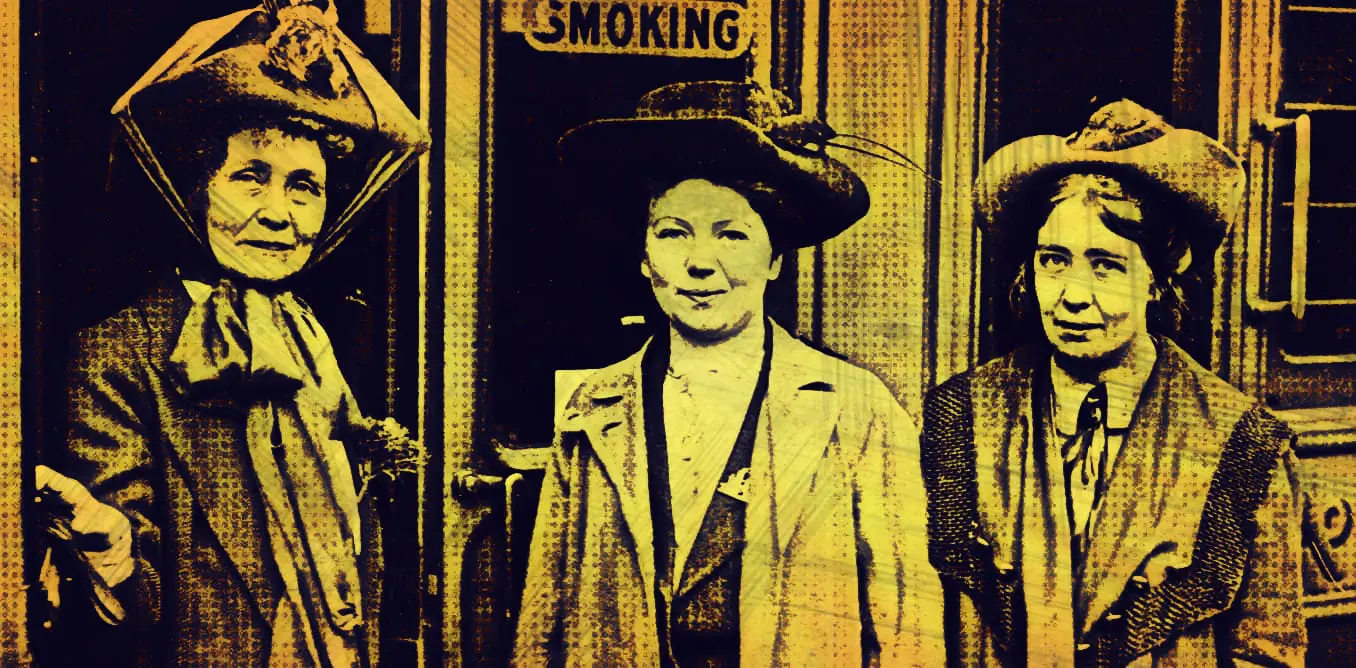
The Pankhurst sisters – Emmeline, Christabel and Sylvia – are the most famous figures in the British suffrage movement, and their story is also the story of its central tensions. Emmeline founded the Women’s Social and Political Union in 1903 with the motto “Deeds, Not Words”, and escalated the campaign through window-smashing, arson, hunger strikes and the force-feeding of imprisoned suffragettes that produced some of the most disturbing testimony of the era. Christabel supported her mother’s increasingly militant strategy. Sylvia, working in the East End of London, refused: she believed that working-class women’s liberation had to be part of any genuine suffrage movement, not an afterthought.
The divergence between the Pankhurst sisters is a microcosm of a tension that runs through all feminist politics: between those who seek inclusion in existing power structures and those who seek to transform those structures entirely. Emmeline and Christabel wanted women to have the vote on existing terms, the terms that already excluded working-class men. Sylvia wanted a different kind of politics altogether, one that linked women’s suffrage to labour rights, to anti-imperialism, to a fundamental critique of the economic system that produced women’s subordination alongside class subordination.
The Matchgirls’ Strike of 1888 belongs to the same moment and the same struggle. When young women at Bryant & May’s match factory in east London walked out over toxic working conditions and poverty wages, organised by Annie Besant and supported by the wider labour movement, they were not simply demanding better treatment. They were insisting, in one of the most precarious positions imaginable, that their lives and their health were worth protecting. Their victory established the principle that even the most vulnerable workers could organise effectively, and it helped build the trade union movement that would fight, over the following decades, for the conditions that most workers now take for granted.
“I am no longer accepting the things I cannot change. I am changing the things I cannot accept.”
Angela Davis
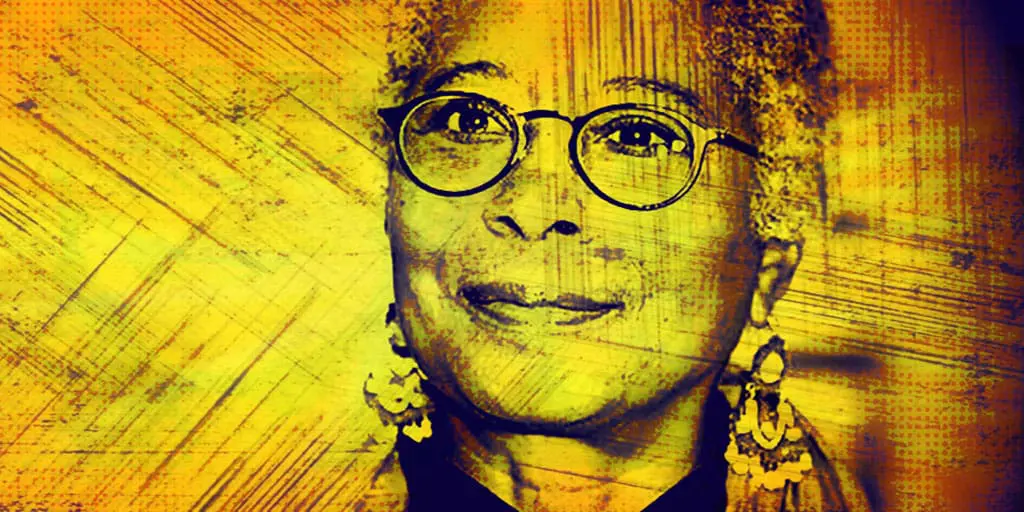
Angela Davis – scholar, activist, icon
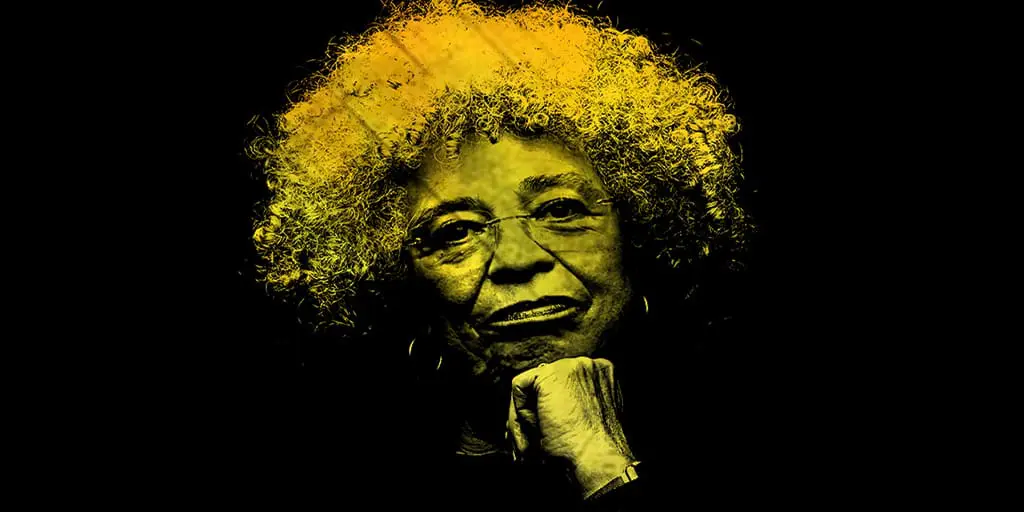
Angela Davis is one of the most important radical intellectuals of the twentieth century, and one of the most systematically misrepresented. In her case the FBI placed her on its Most Wanted list in 1970 on charges that were later dropped; she was imprisoned for sixteen months; she was acquitted by an all-white jury in 1972 and became a global symbol of resistance at a moment when the American state was explicitly at war with the Black liberation movement.
But Davis’s significance extends far beyond her biography. Her intellectual work – on the prison-industrial complex, on the intersections of race, gender and class, on the relationship between Black liberation and feminist politics – has shaped political theory for fifty years, and her arguments about prison abolition have moved from the margins to the mainstream of progressive politics in the two decades since she first made them systematically available. She represents a tradition of Black feminist thought that insists on the interconnectedness of all forms of oppression: that you cannot end racism without ending capitalism, that you cannot end capitalism without ending patriarchy, that liberation is either intersectional or it is not liberation.
“The most common way people give up their power is by thinking they don’t have any.”
Alice Walker
Alice Walker – writer, activist, womanist
Alice Walker‘s The Color Purple, which won the Pulitzer Prize in 1983 and was banned from school libraries across the American South, did something that American literature had, with very few exceptions, failed to do: it placed at its centre the inner life of a poor, Black, Southern woman and treated that inner life as a site of profound moral intelligence, resilience and ultimately joy. The novel is not only a literary achievement. It is a political act: the assertion that Black women’s experience is a worthy subject for serious literature, that their suffering and their strength deserve representation, and that their voices can produce art of the highest quality.
Walker has also contributed the concept of “womanism” to political theory it’s a term she coined to describe a feminism that is rooted in the specific experience of Black women, that includes men rather than opposing them, and that is committed to the survival and wholeness of an entire people rather than the advancement of a single gender. Womanism is not a substitute for feminism. It is a correction and an expansion: a reminder that feminism, like any politics, must attend to the intersections of the oppressions it seeks to address.
The Rosenstrasse Protest – resistance in the darkest place
In February 1943, as the Nazi regime was preparing to deport the last Jews remaining in Berlin, a group of non-Jewish German women (who were the wives of Jewish men who had been rounded up and held in a building on the Rosenstrasse), gathered outside and refused to leave. They stood in the cold, in a city under Nazi rule, chanting and demanding the release of their husbands. After a week, Goebbels ordered the men released. The Rosenstrasse Protest is the only recorded instance of a public street protest in Nazi Germany that succeeded in directly reversing a deportation order.
This is not a story of exceptional heroism in the conventional sense. The women who protested were not revolutionaries or political theorists. They were ordinary women who had been pushed to the point at which ordinary compliance became impossible. Their action demonstrates something that the official histories of the Third Reich have struggled to accommodate: that even within the most totalitarian state imaginable, collective public refusal by ordinary people could occasionally succeed. The story is important not only as an account of individual courage but as evidence of the limits of state power when confronted with people who have decided, collectively and publicly, not to accept what is being done.
“When women are in charge of their own culture, everything changes.”
Guerrilla Girls
Women in the arts – from the Guerrilla Girls to Alice Walker
Women’s history in the arts is, in large part, a history of exclusion and recovery: the exclusion of women from the formal institutions of cultural production, the academies, the publishing houses, the concert halls, the galleries and the recovery of work that was produced despite that exclusion, often under pseudonyms, often without credit, often in the domestic spaces to which women were confined. The Guerrilla Girls have documented this exclusion with devastating statistical precision: their analysis of major museum collections consistently shows that works by women represent a tiny fraction of what is exhibited and collected, and that this underrepresentation is then naturalised as a reflection of aesthetic merit rather than structural exclusion.
The feminist art movement of the 1970s and 1980s was a systematic attempt to challenge this exclusion: to create new institutions, new criteria of value, and new forms of artistic practice that were adequate to women’s experience. Judy Chicago’s The Dinner Party, Barbara Kruger’s text-image combinations, Cindy Sherman’s self-portraits – these are not simply women’s art. They are arguments about what art can be, and who it is for.
Women in science – from Rosalind Franklin to Jocelyn Bell Burnell
Women’s history in science mirrors the same pattern of exclusion and recovery that defines their place in the arts: exclusion from laboratories, universities, and professional recognition, and the later recovery of discoveries that were always foundational but rarely credited. Scientific knowledge has often been presented as objective and meritocratic, yet its institutions have historically limited who could participate and who could be seen. Caroline Herschel catalogued the heavens in the 18th century while working in her brother’s shadow, her discoveries essential but unevenly recognised. A century later, Sophia Louisa Jex-Blake had to fight simply to access medical education, transforming exclusion into institutional change by helping establish pathways for women in medicine.
The 20th century did not resolve these tensions but made them more visible. Rosalind Franklin’s X-ray diffraction image of DNA provided the crucial evidence for the double helix, yet recognition was redirected elsewhere, her contribution only fully acknowledged after her death. Decades later, Jocelyn Bell Burnell identified pulsars – one of the most important astrophysical discoveries of the century – but was excluded from the Nobel Prize awarded for the work. These are not anomalies but expressions of a broader structure in which authority, authorship, and recognition have been unevenly distributed.
As in the arts, the late 20th and early 21st centuries have seen a concerted effort to confront this imbalance. The recovery of women’s scientific contributions has not simply corrected the historical record; it has reshaped how science itself is understood. These stories reveal that discovery has always depended on minds working at the margins of recognition, and that the expansion of science is inseparable from the expansion of who is allowed to participate in it.

“I am not free while any woman is unfree, even when her shackles are very different from my own.”
Audre Lorde
What women’s history demands of us
Reading women’s history is not simply an act of recovery, of finding what was lost and restoring it to its rightful place. It is an act of political analysis: of understanding why it was lost, who benefited from its loss, and what would need to change for women’s contributions to be fully acknowledged and fully valued. Those questions do not have comfortable answers. They require attending to the structures of power in institutions, in economies and in cultures that have systematically undervalued and suppressed women’s work, and asking what it would take to transform those structures.
They also require attending to the women who have done this transforming, whether it’s the market women who marched to Versailles, the matchgirls who organised their own union, the suffragettes who chained themselves to railings, the Black feminist intellectuals who insisted that liberation had to be intersectional or it would be nothing. Their stories are the evidence for what is possible. They are also the inheritance that every subsequent generation of women and every subsequent person who cares about justice has the responsibility to receive, to understand, and to carry forward.
Read the full accounts of the Matchgirls’ Strike, Rosenstrasse Protest, Art and power – who gets to make art and be represented and The ground breaking women in Science – and understand that the history of women is the history of the world, properly told.
For more on women’s history and political resistance, explore our Resistance and Solidarity hub, our account of the Women’s March on Versailles and our profiles of Angela Davis and the Pankhurst sisters.
“We are the granddaughters of the witches you couldn’t burn.”
Tish Thawer
Pen vs Sword Books – Book Recommendations
*All Book Links Open a New tab to our Pen vs Sword Books Bookshop
**If you buy books linked to our site, we get 10% commission from Bookshop.org, whose fees support independent bookshops.
1. Women, Race and Class by Angela Davis
Davis’s foundational account of the intersections of gender, race and class in American history — essential reading for understanding women’s history as a political tradition.
2. The Color Purple by Alice Walker
Walker’s Pulitzer Prize-winning novel – a story of survival, joy and the political power of representing lives that have been made systematically invisible.
3. The Suffragette Movement by E. Sylvia Pankhurst
Sylvia Pankhurst’s own account of the British suffrage campaign – indispensable as both history and document of political thought.
4. A Room of One’s Own by Virginia Woolf
Woolf’s foundational essay on women, writing and the material conditions that make either possible – one of the most important texts in feminist political thought.
5. The Second Sex by Simone de Beauvoir
The philosophical foundation of modern feminism – de Beauvoir’s account of how women are constructed as “other” remains indispensable seventy years after its publication.
6. Sister Outsider by Audre Lorde
Lorde’s collected essays and speeches – the most important body of Black feminist political thought of the twentieth century.
7. We Should All Be Feminists by Chimamanda Ngozi Adichie
The most accessible and widely read introduction to feminism of recent years – Adichie’s TED talk in essay form.
8. The Feminine Mystique by Betty Friedan
The book that launched the second wave of American feminism in 1963 – its diagnosis of “the problem that has no name” remains relevant to contemporary conversations about women’s work and identity.
“If you want something said, ask a man; if you want something done, ask a woman.”
Margaret Thatcher
JOIN THE PVS READERSHIP
Browse 1000’s more Books in Our Pen vs Sword Books Bookshop
About the Author
Pen vs Sword is an independent magazine publishing long-form cultural criticism, art history and political analysis. We write about artists, movements, thinkers and ideas - from Peter Kennard to Hurufiyya, from the Suffragette movement to the French Revolution. Free to read, independently published.





Post Comment